Announcing Arazzo UI: Visualize API Workflows

Frank Kilcommins
Estimated read time: 5 min
Last updated: March 3, 2026
Announcing Arazzo UI: Visualize API Workflows
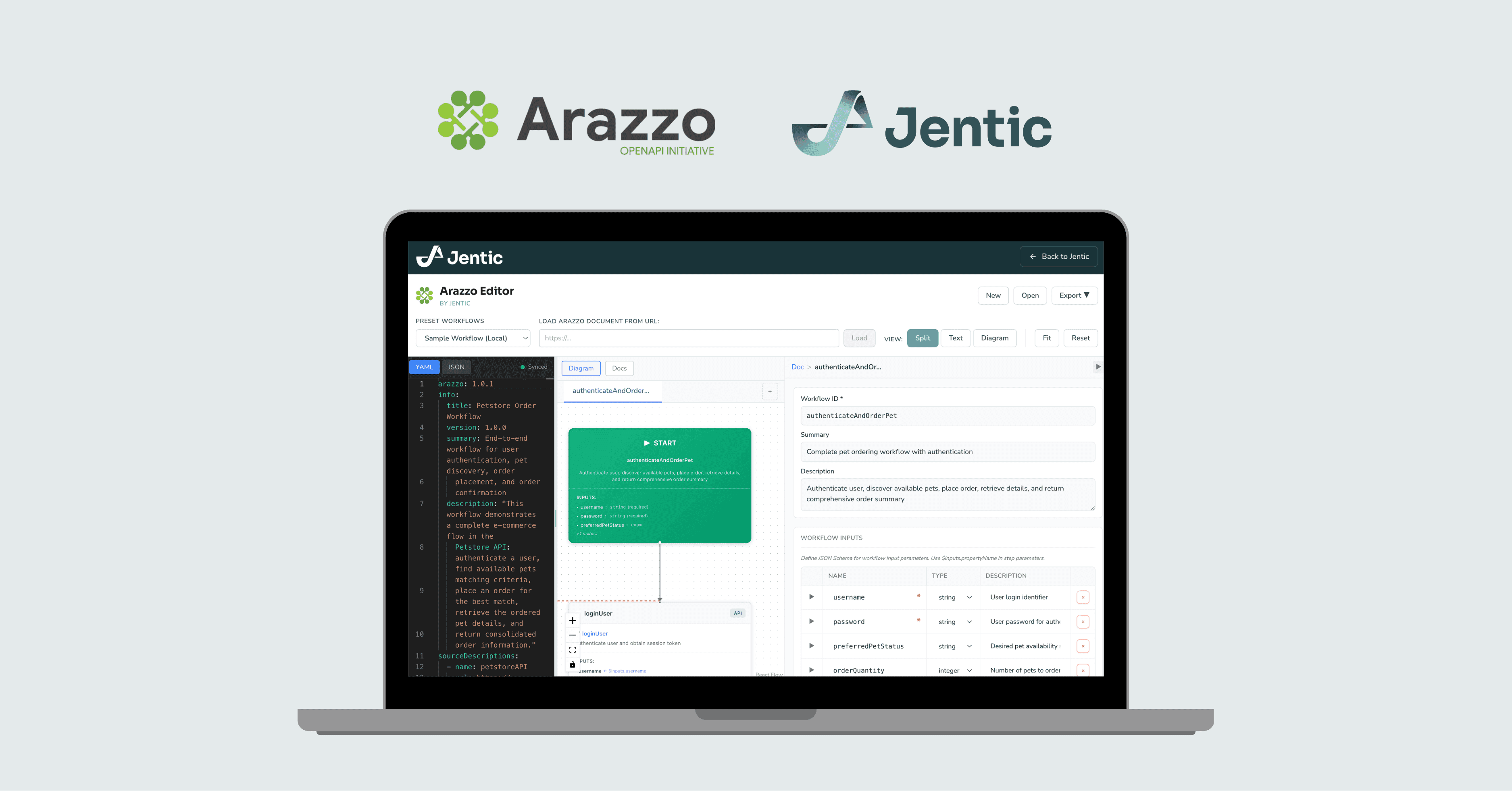
We have released Arazzo UI today, an open-source visualization tool for Arazzo workflow documents.
It takes your Arazzo YAML or JSON documents and renders the workflow(s) as diagrams and documentation. You can load local files or point it at remote workflow documents via URL, there's no configuration, no setup, no friction, and you don't have to read raw YAML or JSON.
Think SwaggerUI or Scalar for OpenAPI, but for API workflows. It's live at arazzo-ui.jentic.com, and the source is on GitHub.
What Problem This Solves
Arazzo workflows encode multi-step orchestration logic: step dependencies, conditional branching, runtime expressions, data flow between operations, error handling paths. Arazzo supports both JSON and YAML formats, which machines and agents are great at dealing with, but this is cognitively challenging to parse as humans. Imagine a 15-step workflow with conditional logic which might be 300 lines of nested YAML. As humans, we much prefer graphical representations.
Arazzo UI addresses this with multiple visualization modes: sequence diagrams show API interactions over time, flow diagrams expose decision trees and execution paths, and documentation views provide structured textual representation. You get different perspectives on the same workflow logic, meaning it's good for developers, architects, product owners, and other stakeholders who care about exposing capabilities to consuming developers and business agents.
The practical benefits:
- Share workflows visually: Share any accessible Arazzo document via URL using the document query parameter:
https://arazzo-ui.jentic.com?document=https://example.com/workflow.arazzo.yaml - Onboard faster: New team members see the workflow structure first, then only dive into YAML for implementation details when or if needed.
- Present to stakeholders: Business owners and product managers understand workflow decisions without reading raw documents, improving understanding and approval flows.
- Integrate and debug smarter: Trace data flow and execution paths visually prior to integration or when troubleshooting. Find where
$steps.auth.outputs.tokenoriginates without grep-ing through documents.
Consider a workflow with retry logic: an API call with multiple failure actions based on different error codes (503 triggers retry with 2-second backoff, 429 triggers retry with 5-second backoff, other errors go to a logging step). In YAML, you read three separate onFailure blocks, each with nested criteria and retry parameters. In a flow diagram, you see three distinct failure branches with labeled retry loops and a convergence point at the logging step. The execution tree is instantly clear.
Where This Fits: Building the Arazzo Tooling Ecosystem
Arazzo UI is another example of Jentic's commitment to building best-in-class Arazzo tooling. This is the entry point for those looking to render and share workflows for better understanding, and faster integration times. It's built upon our foundational Arazzo open-source components to ensure appropriate document parsing and resolving.
- Arazzo UI: Visualization and sharing. Explore workflows without editing complexity.
- Arazzo Editor: Synchronized visual and code-based editing with real-time specification conformance validation. IDE-style features for power users, form-based editing for structured changes.
- Jentic Platform: When workflows become production infrastructure requiring execution orchestration, governance, policy enforcement, and operational observability at scale, that's where the platform fits.
We're combining the best of our open source and entry point tooling starting with visualization (no barriers, no friction), then enabling you to move to authoring to build and evolve workflows, and then scale with platform management as workflows become business-critical infrastructure.
One of the main reasons I joined Jentic is that we're building the ecosystem that Arazzo, and the teams adopting it, deserve. Open standards require open tooling, and Jentic is committed to both.
Why This Matters: Workflows as Enterprise IP
Arazzo workflows aren't documentation artifacts. They're executable business logic.
The "payment authorization with fraud detection" workflow represents validated, repeatable knowledge. So does the "multi-API customer onboarding sequence" that spans three internal services and two external partners. These are enterprise assets—intellectual property that encodes how your systems actually operate.
This becomes more critical as AI agents become primary API consumers. Agents executing predefined workflows don't burn tokens planning multi-step sequences or holding operational state in context. They follow validated orchestration logic, saving tokens, protecting context, and ensuring consistent execution. The workflow is the contract, not something agents invent each time.
But if your team can't understand workflows without archaeological work, you can't maintain them, evolve them, or scale them. That's untenable as they become more central to how AI agents interact with your systems. We don't want agents inventing our business logic, we want them using it.
Visualization ensures workflow logic remains legible as it becomes more critical. Machine-readable doesn't have to mean human-hostile. Arazzo workflows are designed for deterministic execution by agents and orchestrators—but humans review them, debug them, and evolve them. Arazzo UI is part of that journey.
Getting Started
Try it now at arazzo-ui.jentic.com. Load your workflows or explore examples to see how visualization changes comprehension.
Share any workflow by passing its URL via the document query string parameter:
https://arazzo-ui.jentic.com?document=https://your-domain.com/workflow.arazzo.yaml
You can also open any accessible Arazzo document directly from the command line:
npx @jentic/arazzo-ui https://arazzo-ui.jentic.com/petstore-order-workflow.arazzo.yaml
This opens the workflow in your preferred browser, ready to visualize.
The project is open source and available at github.com/jentic/jentic-arazzo-tools. Feedback and contributions welcome.
Arazzo UI allows you to start visualizing your workflows today. When you need to build and evolve them, Arazzo Editor adds synchronized visual and code-based authoring with real-time validation—moving you from understanding workflows to creating them.