Scoring APIs for the Age of AI

Erik Wilde
Estimated read time: 4 min
Last updated: December 17, 2025
APIs have become a critical interface not just for developers but increasingly for AI agents that need to understand, evaluate, and reliably interact with enterprise capabilities. As organizations expand their AI adoption, one theme is becoming impossible to ignore: AI systems are only as effective as the APIs they depend on.
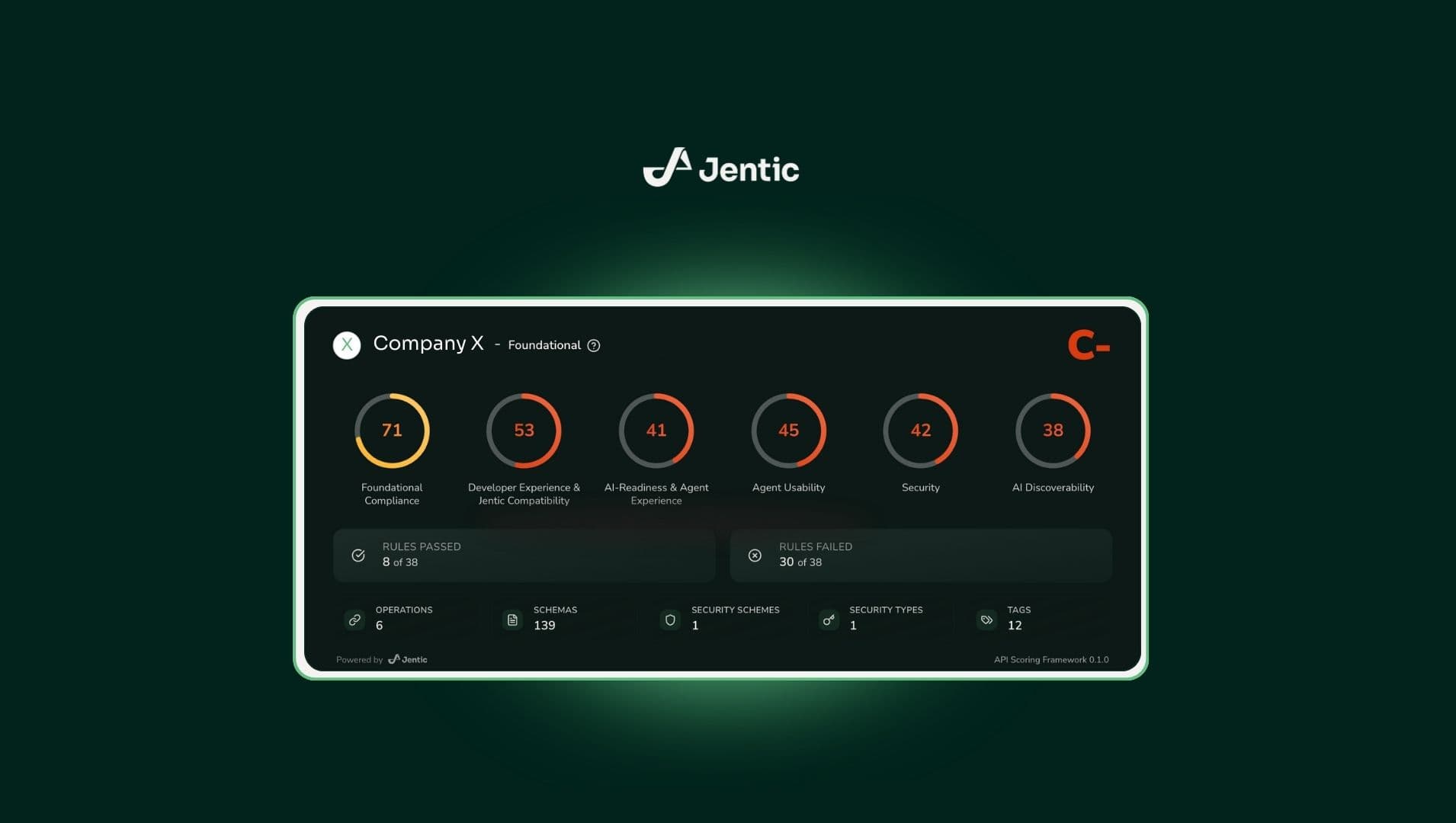
Below is a conversation with Frank Kilcommins, Head of Enterprise Strategy at Jentic, where we explore a practical model for scoring APIs along six dimensions of AI readiness.
Why API Quality Now Matters More Than Ever
Traditional API design has always balanced functionality, clarity, and usability. With AI entering the picture, the demands shift. Agents can’t infer intent that isn’t expressed, they can’t guess correct usage when schemas are ambiguous, and they can’t navigate sprawling API landscapes without structured cues.
Learn more about Jentic's AI Readiness Scorecard here: www.jentic.com/scorecard
Improving API quality is not about optimizing for AI alone; it’s about creating an ecosystem that works better for everyone. Better documentation, clearer semantics, and more consistent models help humans and machines alike. The scoring approach in the video outlines a framework that teams can use to understand where their APIs excel and where they need attention.
Six Dimensions of API Readiness
1. Foundational Compliance
This dimension establishes the baseline: is the API structurally sound, standards-compliant, and internally coherent? The goal is to ensure that any API entering an AI ecosystem is healthy at the core—free from structural surprises that could derail automation or mislead downstream tools.
2. Developer Experience & Tooling Compatibility
Here the focus shifts from structure to usability. The aim is to assess how effectively an API communicates its purpose to developers and tools. Good examples, meaningful descriptions, and consistent patterns make APIs more approachable and also give machines a fighting chance at correct interpretation.
3. AI-Readiness & Agent Experience
This lens examines how well an API expresses its intent: what an operation is supposed to do, what its boundaries are, and how its semantics align with actual behavior. AI systems rely heavily on these signals. The objective is to determine whether an API is precise and expressive enough for autonomous reasoning, planning, and execution.
4. Agent Usability
Even with clear intent, an API may be difficult for agents to use if it is overly complex, ambiguous, or inconsistent. This dimension looks at how predictable and navigable the API is for agents making decisions without human guidance. The goal is to understand whether an API’s shape and structure support safe and reliable autonomous use.
5. Security
Security in this context is about more than protecting systems; it’s about making sure AI agents operate safely. This dimension evaluates whether the API provides the necessary signals—authentication, safe operation boundaries, and consistent patterns—so that automation can proceed without unintended consequences.
6. AI Discoverability
As organizations accumulate thousands of APIs, the biggest challenge is no longer usage but finding the right capability at the right time. Discoverability focuses on the cues that help agents identify, classify, and select APIs based on context and intent. The goal is to make capabilities visible and understandable within a large and evolving landscape.
A Second Wave of API Maturity
The industry has already experienced one major wave of API improvement driven by mobile, integrations, and microservices. AI is now triggering the next wave—one that benefits everyone. Focusing on clarity, consistency, semantic richness, and discoverability yields a landscape that is better for humans and essential for machines.
This video is an early look at how we are thinking about API readiness and what organizations can do to prepare their ecosystems for increasingly autonomous consumption.
To learn more about Jentic's AI Readiness Scorecard, visit: www.jentic.com/scorecard